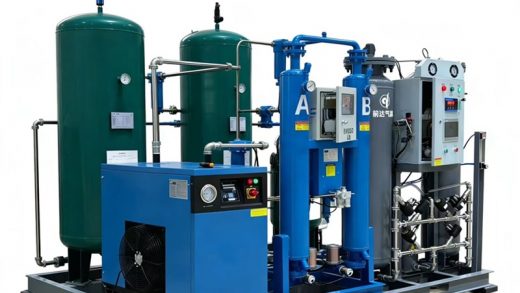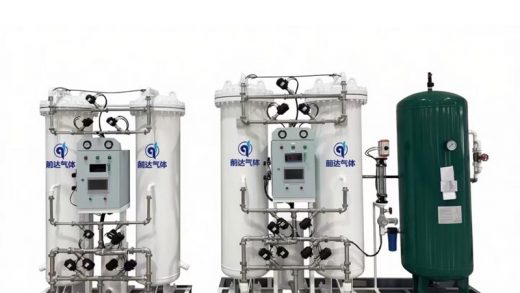

There are three primary industrial supply methods for oxygen: cryogenic air separation, pressure swing adsorption (PSA), and membrane separation. Cryogenic air separation, based on low-temperature rectification, can produce oxygen with a purity exceeding 99.5%, but its equipment is large-scale, requires long startup times (usually several hours), and consumes high energy. PSA technology is positioned for medium-to-high purity (90%–95%) and small-to-medium scale (from several to hundreds of Nm³/h) on-site oxygen generation scenarios. Compared to cryogenic separation, a PSA unit features a simpler structure, operates at ambient temperature and low pressure, starts up rapidly (producing qualified oxygen within 15–30 minutes), and the production process involves no chemical reactions or organic solvents. It is a purely physical separation process with no risk of environmental pollution.
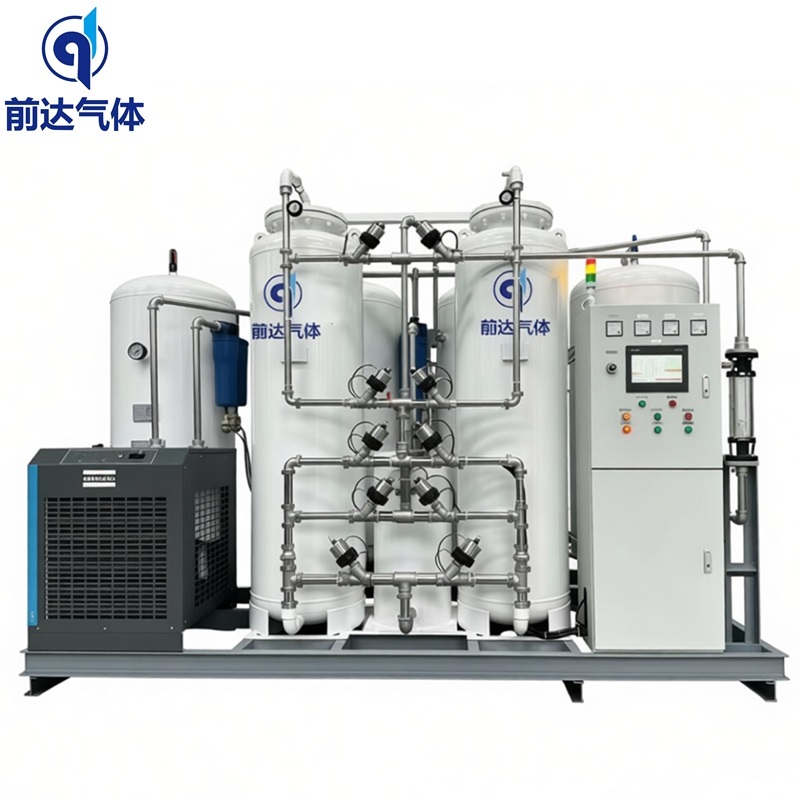
The conceptual history of pressure swing adsorption dates back to the 1960s. Skarstrom proposed the classic four-step PSA cycle in 1960, and almost concurrently, Exxon and Air Liquide independently developed air separation processes based on nitrogen-selective zeolites. In the decades since, with advances in zeolite molecular sieve synthesis and modification technologies—notably the commercialization of Li-LSX (Lithium Low-Silica X-type zeolite)—the separation efficiency and energy consumption levels of PSA have been continuously optimized, evolving from an initial laboratory concept into a mature industrial technology.
Today, a typical dual-tower PSA oxygen generation system can operate continuously for thousands of hours in an unattended mode, with unit power consumption reduced to 0.3–1.0 kWh/Nm³, covering numerous differentiated scenarios from medical oxygen supply in remote clinics to oxygen-enriched combustion in ten-thousand-ton glass furnaces.
Core Principles of Adsorption Separation
Selective Adsorption: Thermodynamic Basis
The essence of PSA oxygen generation is a gas separation method based on differences in adsorption equilibrium. When compressed air passes through an adsorption bed packed with zeolite molecular sieves, the components in the gas phase undergo physical adsorption onto the surface and within the micropores of the sieves. Because different gas molecules exhibit significantly different van der Waals forces (including dispersion forces, dipole-dipole interactions, and quadrupole moment-electric field gradient interactions) with the adsorbent, the molecular sieve has a much higher adsorption affinity for nitrogen than for oxygen.
The nitrogen molecule possesses a large quadrupole moment (approximately –1.52×10⁻²⁶ esu·cm²), whereas the oxygen molecule’s quadrupole moment is smaller (approximately –0.39×10⁻²⁶ esu·cm²). The local electric field gradients generated by exchangeable cations (such as Li⁺, Ca²⁺, Na⁺) in the zeolite framework interact strongly with nitrogen’s quadrupole moment. This constitutes the fundamental thermodynamic driving force for nitrogen/oxygen selective separation. Research has shown that 13X zeolite modified by Li⁺ ion exchange exhibits significantly enhanced nitrogen adsorption capacity at active cation sites.
Under conditions of 25°C and 1 bar, the equilibrium selectivity coefficient α(N₂/O₂) for a typical AgLiLSX adsorbent is approximately 4.98, while the argon/oxygen selectivity is only about 1.14. This indicates a high selectivity for nitrogen but a weak separation capability for argon—a property that directly determines the theoretical upper purity limit of the PSA oxygen generation process (detailed in Section 5).
Molecular Sieve Selection: 5A, 13X, and Li-LSX
The molecular sieve is the “heart” of a PSA system. Currently, there are three main types of zeolites used in the commercial PSA oxygen generation field:
5A Molecular Sieve: Pore size of about 5 Å (0.5 nm), typically a calcium ion-exchanged A-type zeolite. Its nitrogen adsorption capacity under standard operating conditions can reach 14%–18% (mass fraction), with a single-particle crushing strength higher than 30 N (for 1.6 mm cylindrical pellets). The high nitrogen selectivity and good mechanical strength of 5A molecular sieve make it the standard choice for PSA oxygen generators, capable of stably producing oxygen with a purity of 90%–95%. It should be noted that 4A molecular sieve with a smaller pore size (about 4 Å) is mainly used as a dehydration desiccant and is not suitable for oxygen/nitrogen separation.
13X Molecular Sieve: X-type zeolite has a lower silicon-to-aluminum ratio and a higher framework negative charge density, containing more exchangeable cation sites, resulting in a higher nitrogen adsorption capacity. In simulation studies for commercial aviation onboard oxygen generation systems, 13X zeolite has been verified to achieve efficient oxygen/nitrogen separation under process conditions more complex than the classic Skarstrom cycle.
Li-LSX Molecular Sieve: Low-silica X-type zeolite exchanged with Li⁺ ions further enhances the electrostatic interaction between the adsorbent and nitrogen. This is one of the highest known nitrogen/oxygen equilibrium selectivity commercial adsorbents available and the preferred material for high-end medical and industrial PSA units. Li-LSX can achieve a higher nitrogen working capacity at lower adsorption pressures, helping to reduce the compression energy consumption of the system.
Differences in Adsorption Behavior of Three Main Air Components
Dry ambient air contains approximately 78.08% nitrogen, 20.95% oxygen, and 0.93% argon by volume, along with trace amounts of carbon dioxide (about 0.04%) and moisture. Inside a PSA adsorption bed, the adsorption behavior of these components presents a clear hierarchy:
- Water Vapor and Carbon Dioxide: These have the strongest polarity and are adsorbed first and most firmly at the zeolite pore openings and channel entrances. If the feed air contains water, it will severely occupy adsorption sites, drastically reducing the nitrogen adsorption capacity. Therefore, dry compressed air is the primary prerequisite for the normal operation of a PSA system.
- Nitrogen: As described in the previous section, it is preferentially adsorbed due to the strong interaction between its quadrupole moment and the cation electric field, making it the main target component for adsorptive separation.
- Argon: As a monatomic molecule, argon lacks a quadrupole moment and interacts weakly with the zeolite. Its adsorption characteristics are relatively similar to oxygen, making it the most difficult component to separate from the oxygen stream in a PSA process. For this reason, the theoretical upper purity limit of PSA oxygen generation is about 95.45% (the oxygen enrichment limit after removing the inseparable argon).
- Oxygen: After nitrogen is selectively adsorbed, oxygen, as a non-preferentially adsorbed component, passes through the bed and is enriched at the outlet, becoming the target product gas.
PSA Cycle Process: From Skarstrom to Modern Multi-Step Cycles
The Classic Four-Step Skarstrom Cycle
The classic dual-tower Skarstrom cycle is the foundational prototype of the PSA process, consisting of the following four sequential steps:
Step 1 — Pressurization / Adsorption: Clean, compressed, dried, and filtered air enters Adsorption Tower A from the bottom. The pressure inside the tower gradually increases to the operating pressure (typically 3–7 bar(g)). Under high pressure, the zeolite molecular sieve preferentially adsorbs nitrogen, and oxygen-enriched gas flows out from the top of the tower into a buffer tank. This step is the oxygen production phase.
Step 2 — Equalization / Blowdown (Depressurization): When Adsorption Tower A approaches the nitrogen breakthrough point (i.e., the adsorption front is about to escape from the top of the tower), the feed air is stopped. Tower A is connected to the already regenerated Tower B for pressure equalization (equalization step), recovering the void gas in Tower A while helping pre-pressurize Tower B. Subsequently, Tower A is depressurized to near atmospheric pressure, and the adsorbed nitrogen desorbs from the molecular sieve and is vented.
Step 3 — Counter-current Purge (Regeneration): A portion of the product oxygen (from Tower B or the buffer tank) is used to purge Tower A in a counter-current flow direction, further carrying away residual nitrogen and completing the deep regeneration of the molecular sieve. The volume ratio of purge gas to product gas (P/F ratio) is a critical operational parameter affecting regeneration quality and product purity.
Step 4 — Repressurization: Tower A is repressurized to the operating pressure using feed air or equalization gas from Tower B, preparing for the next adsorption cycle. Meanwhile, Tower B is already in the adsorption/production phase. The two towers alternate cycles to achieve continuous oxygen generation.
The switching cycle of the two towers is typically on the order of 6–15 seconds. The system uses a PLC (Programmable Logic Controller) to control the switching of pneumatic butterfly valves according to a preset logic sequence, achieving fully automatic operation.
Expansion of Modern Multi-Step Cycle Processes
In practical engineering, to improve oxygen recovery and reduce energy consumption, modern PSA units often adopt extended six-step or eight-step cycle processes. Common extension steps include:
- Pressure Equalization Step: One or more pressure equalizations are introduced between the depressurization of one tower and the pressurization of another, recovering the void gas energy from the high-pressure tower. Studies have shown that adding an equalization stage can increase the process recovery rate of PSA by about 18.9%, and for VSA processes by about 14.5%.
- Co-current Depressurization: Before counter-current nitrogen venting, a proper depressurization along the gas flow direction is performed to discharge residual oxygen-enriched gas remaining in the bed for equalization or purge use, reducing product loss.
- Product Backfill / Purge: A portion of the product oxygen is used for counter-current purge regeneration and pre-pressurization of the other tower, further enhancing bed regeneration quality.
Although these extended steps increase the complexity of the valve switching logic, they can significantly improve the economics of large-scale industrial installations.
Coupling Relationships Between Operating Parameters, Purity, and Recovery
The performance of a PSA system is subject to the cross-influence of multiple operating parameters, among which the following four are the most critical:
Adsorption Pressure: Increasing the adsorption pressure usually enhances the driving force for nitrogen adsorption, which is beneficial for improving product purity, but it also increases the shaft power consumption of the compressor. The operating pressure of industrial PSA units is generally set between 4–7 bar(g).
Cycle Time (Adsorption Time): A shorter adsorption time helps maintain higher oxygen purity because the nitrogen adsorption front has not yet broken through the bed. However, too short an adsorption time reduces the effective working time proportion, decreasing the total oxygen production per unit time of the adsorbent. Conversely, extending the adsorption time can increase throughput (productivity and recovery rise), but it leads to a decrease in purity due to nitrogen breakthrough. Research indicates that under conditions of 1.5 bar adsorption pressure and 0.1 bar desorption pressure, an adsorption time of approximately 7.5 seconds can achieve around 94% purity and about 20% recovery. Generally, the half-cycle time of industrial PSA units is designed within the range of 30–120 seconds (related to tower size, bed height, and operating pressure).
Purge Ratio (P/F Ratio): The ratio of purge gas quantity to product gas quantity directly affects the depth of regeneration. Too low a P/F ratio leads to insufficient molecular sieve regeneration, causing residual nitrogen to decrease the product purity in the next cycle. Too high a P/F ratio consumes excessive product oxygen, lowering the overall recovery rate. The typical P/F ratio range is between 0.5–1.5, which needs to be optimized through experiments or simulations.
Operating Temperature: Temperature has a significant impact on the equilibrium adsorption capacity of the zeolite. Under the same partial pressure, lower temperatures increase the nitrogen adsorption capacity, favoring separation; however, too low a temperature makes nitrogen desorption more difficult during the desorption step. Ambient temperature operation (20–45°C) is a reasonable choice for most PSA units. Feed gas temperature around 30°C usually yields optimal overall performance.
Dead Volume: The gas in the dead volumes of pipelines, valves, and instrument connectors at the top of the adsorption tower undergoes repeated compression and expansion during the pressure cycle, diluting the product gas purity. Both experimental and simulation studies show that an increase in dead volume adversely affects purity, productivity, and recovery, and should be minimized during system design.
Composition and Engineering Architecture of a PSA Oxygen Generation System
A complete PSA oxygen generation system typically consists of the following functional modules connected in series:
(1) Compressed Air Source System — Includes a screw or piston air compressor, refrigerated or adsorption air dryer, compressed air buffer tank, and multi-stage precision filters (for oil removal, dust removal, and liquid water separation). The compressed air source provides the PSA module with clean, dry intake air at a stable flow rate and pressure, serving as the “power heart” of the entire system. The intake air dew point typically needs to be controlled below –20°C (at atmospheric pressure) to avoid irreversible damage to the molecular sieve from moisture.
(2) PSA Separation Module — Namely the oxygen generator main unit, composed of two adsorption towers operating alternately, a bank of pneumatic switching butterfly valves, a PLC electrical control system, and connecting pipelines. It is the core execution unit for oxygen/nitrogen separation. The adsorption towers are filled with selective molecular sieves, and the tower bodies are typically made of carbon steel or stainless steel with an internal anti-corrosion lining design. The response speed and sealing performance of the switching valves are critical to ensuring the long-term stable operation of the system.
(3) Oxygen Buffering and Post-Treatment System — Includes an oxygen buffer tank (to smooth oxygen flow fluctuations), an online oxygen purity analyzer, a sterilization filter (for medical configurations), and optional gas boosting and cylinder filling stations.
(4) Optional Auxiliary Systems — Medical-grade units require additional coalescing filters and bacterial filters to meet pharmacopoeia requirements for microbial and particulate limits in medical oxygen. Some industrial units are also integrated with dew point sensors, temperature and pressure transmitters, and remote monitoring terminals, supporting full-parameter real-time data acquisition and network alarms.
Purity Standards and Technical Boundaries
The Origin of Medical Oxygen 93 Percent
PSA oxygen generation cannot produce 100% pure oxygen, fundamentally due to the argon co-adsorption problem discussed earlier. Approximately 0.93% of argon in the air is nearly inseparable from oxygen in current commercial PSA processes, meaning the theoretical upper purity limit is (20.95% + 0.93%) ÷ (100% – 78.08%) ≈ 95.45%. In practical engineering, pursuing purity above 95% requires a significant increase in bed height and purge flow, causing a sharp decline in economic viability and making it difficult to maintain purity stably.
Therefore, the industry-recognized standard purity for PSA oxygen is 93% ± 3% (i.e., a lower limit of 90% and an upper limit of 96%). The United States Pharmacopeia (USP) has listed “Oxygen 93 Percent” produced by molecular sieve PSA as an official drug monograph since 1990, specifying its purity as “not less than 90.0% and not more than 96.0%” (by volume), with the remainder being mainly argon and nitrogen. China’s pharmaceutical industry standard YY/T 0298–1998 also specifies technical requirements for 93% medical oxygen produced by the PSA method.
Essential Differences Between Industrial Oxygen Purity and Medical Oxygen
Industrial PSA oxygen generators typically claim an output purity of 90%–95%, and some low-demand application scenarios (such as oxygen-enriched combustion, aeration) can even accept purity levels of 80%–90%. It is crucial to note that industrial-grade oxygen and medical oxygen differ not merely in purity levels. The regulatory requirements for medical oxygen cover multiple dimensions, including purity, moisture, carbon monoxide, carbon dioxide, oil mist, particulates, and microorganisms. Industrial oxygen has not undergone the aforementioned medical-grade quality control and must never be used for human inhalation.
Technical Reasons for Substandard Oxygen Purity
In engineering practice, common reasons for PSA oxygen purity not meeting the standard (falling below 90%) include:
- Feed air moisture content exceeding the standard, leading to premature molecular sieve deactivation (moisture breakthrough);
- Adsorption time set too long, causing nitrogen to break through the bed;
- Insufficient purge ratio, resulting in incomplete molecular sieve regeneration;
- Internal leakage in switching valves or aging seals causing gas cross-contamination;
- Excessive ambient temperature, reducing the equilibrium adsorption capacity of the molecular sieve;
- Molecular sieve dust accumulation or sintering blockage causing powdering, increasing bed pressure drop and reducing effective adsorption area;
- Excessive dead volume, diluting the product gas with residual gas.
Regular dew point monitoring, online purity recording, and periodic molecular sieve performance spot checks are necessary maintenance measures to ensure the long-term stable operation of the system.
Process Boundary and Selection Logic Between PSA and VPSA
Vacuum Pressure Swing Adsorption (VPSA) is an important extension of PSA technology. The core difference is that the desorption step in PSA is carried out under near-atmospheric pressure, whereas VPSA uses a vacuum pump to evacuate the adsorption tower to a negative pressure (approximately 0.1–0.5 bar(a)) during the desorption stage, allowing for a more thorough removal of adsorbed nitrogen.
The selection between the two processes typically follows this logic:
- PSA: Suitable for small-to-medium oxygen production scales (<200 Nm³/h), with a more compact system structure, relatively lower initial investment, higher operating pressure (4–7 bar(g)), and the product oxygen can usually be directly delivered under pressure.
- VPSA: Suitable for medium-to-large oxygen production scales (>200 Nm³/h). Due to more thorough desorption, the unit power consumption per oxygen output is lower (can be as low as about 0.305 kWh/Nm³), and the utilization rate of the adsorbent is higher. VPSA requires a blower (low pressure) combined with a vacuum pump to achieve pressure swing, resulting in a higher system cost, but the comprehensive cost advantage in large-scale operation is significant.
In scenarios requiring hundreds or thousands of cubic meters of oxygen per day, such as oxygen-enriched combustion in glass furnaces or large-scale wastewater treatment aeration, the VPSA solution typically offers better lifecycle economics.
Additionally, there is a Rapid PSA (RPSA) process, a fast-cycle pressure swing adsorption technique employing a single-tower design with high-frequency pressure cycling (cycle periods reduced to a few seconds). It is suitable for scenarios with strict volume and weight constraints, such as small portable medical oxygen concentrators.
Typical Industrial Application Scenarios
The application of PSA/VPSA oxygen generation technology has penetrated numerous industrial and public utility sectors. The main scenarios include:
- Ozone Generation: PSA oxygen, used as the feed gas for ozone generators, can significantly increase ozone yield and concentration, widely used in water treatment and disinfection systems.
- Glass Industry: Oxygen-enriched combustion in glass furnaces can raise flame temperature, reduce fuel consumption by 30%–60%, and simultaneously cut NOx emissions.
- Aquaculture: Supplying pure oxygen to aquaculture water bodies increases dissolved oxygen levels, enhancing stocking density and survival rates.
- Wastewater Treatment: Pure oxygen aeration promotes the metabolic activity of aerobic microorganisms, accelerating the degradation of organic pollutants.
- Medical Oxygen Supply: Hospital central oxygen supply systems and independent oxygen generation stations in remote clinics.
- Metal Processing: Supply of oxidant for laser cutting, plasma cutting, metal heat treatment, and welding.
- Pulp and Paper: Oxygen delignification and bleaching processes.
- Gold and Precious Metal Extraction: Oxidant supply in cyanide leaching processes.
With its reliable physical separation principle, mature dual-tower cycle process, and continuously iterating molecular sieve materials, PSA oxygen generation technology constitutes a complete and efficient industrial gas solution. From the classic Skarstrom cycle to modern multi-step pressure equalization processes, and from 5A zeolite to Li-LSX high-performance adsorbents, the decades-long evolution of PSA technology has always revolved around two core objectives—enhancing separation selectivity and reducing unit energy consumption. Understanding the thermodynamic nature of adsorption equilibrium and grasping the constraint relationships between cycle parameters and purity/recovery are key to correctly designing, selecting, and operating a PSA oxygen generation system. As emerging fields such as hydrogen energy and carbon capture continue to drive demand for on-site oxygen production, PSA technology still has vast room for engineering innovation.