The Food Manufacturer’s Guide to On-Site Nitrogen Generation
For many food manufacturers, nitrogen is treated as a simple utility—something that arrives on trucks in cylinders or liquid tanks and “just works.” But behind this convenience lies a growing operational problem that is often ignored until it starts hurting the bottom line.
Traditional nitrogen supply models such as gas cylinders and liquid nitrogen (LIN) come with a long list of hidden costs and inefficiencies:
Constantly rising nitrogen prices driven by global energy fluctuation and logistics costs.
Ongoing cylinder rental fees and unpredictable delivery surcharges.
Liquid nitrogen boil-off losses (typically 0.5% to 2% daily) during storage and transport.
Production delays caused by supply chain interruptions or bad weather.
Workplace safety risks associated with high-pressure gas handling and heavy lifting.
For many factories, nitrogen is no longer just a utility—it is a recurring operational burden.
Now in 2026, food manufacturing is entering a new phase of industrial gas independence. With mature On-Site PSA (Pressure Swing Adsorption) Nitrogen Generation technology, factories can finally take control of their nitrogen supply, reduce costs by up to 60–80%, and eliminate supply chain dependency entirely. This is no longer a future concept. It is a proven, industrial-standard solution already adopted across global food packaging lines.
1. Why Food Manufacturers Need Nitrogen? (The Science Behind MAP)
Nitrogen plays a critical role in modern food preservation, especially in Modified Atmosphere Packaging (MAP) systems. MAP is a packaging technology where the air inside a food package is replaced with a controlled gas mixture—primarily nitrogen—to slow down product degradation.
How Nitrogen Protects Food
Nitrogen is an inert, odorless, and tasteless gas, meaning it does not react with food or alter its flavor. In packaging, it performs three essential functions:
Displaces Oxygen inside the package: Aerobic bacteria and mold need oxygen to survive. By dropping residual oxygen levels, you suffocate these spoilage mechanisms.
Inhibits Microbial Growth: It stops the proliferation of micro-organisms without using chemical preservatives.
Prevents Oxidation: Oxidation is the main culprit behind color fading, rancid taste (especially in fats and oils), and texture softening.
Result: Extended Shelf Life
By reducing oxygen exposure, nitrogen significantly extends product freshness and shelf stability. Typical applications include:
2. Cylinder vs. On-Site Generation: The TCO & ROI Comparison
For procurement managers and factory owners, the decision ultimately comes down to one thing: Total Cost of Ownership (TCO). Below is a detailed look at how the two models stack up:
Cost Factor
Cylinder / Liquid Nitrogen
On-Site PSA Nitrogen Generator
Gas Cost
High and fluctuating market prices
Near zero (ambient air is free)
Transportation
Continuous delivery fees required
None
Storage Loss
High (unavoidable boil-off for LIN)
None
Rental Fees
Ongoing cylinder/tank rental
None
Labor Cost
High (handling, moving, and connecting)
Minimal
Downtime Risk
Supply chain dependent
Fully self-sufficient (24/7/365)
The ROI Reality
From an engineering perspective, a standard PSA system consumes approximately 0.35 to 0.45 kWh of electricity per cubic meter of nitrogen produced (at 99.5% purity). Compared to the continuously rising prices of liquid gas delivery, your only ongoing operational cost (OpEx) is your factory’s local electricity bill.
Most food factories experience:
40–80% reduction in total nitrogen expenses.
A typical payback period of 12–24 months on the initial equipment investment.
Long-term operational costs reduced to predictable electricity and minor maintenance.
👉 The math is simple: You stop buying nitrogen as a commodity and start generating it as a utility.
3. What is the Ideal Nitrogen Purity for Food Packaging?
Not all food applications require the same nitrogen purity. Choosing the correct specification is critical for balancing product freshness and energy cost efficiency.
Recommended Purity Levels
99.5% – 99.9% Nitrogen : Ideal for snack foods (chips, popcorn), bakery products, nuts, and dried fruits. This is the optimal sweet spot for balanced performance and energy economy.
99.99% – 99.999% High Purity Nitrogen : Required for premium coffee packaging, milk powder, high-fat content foods (oils, chocolates), and oxygen-sensitive specialty foods.
Why Purity Customization Matters
Higher purity requires more compressed air, which increases energy costs. That’s why modern industrial PSA systems are designed with adjustable purity control. A well-engineered system ensures you always meet your food safety requirements without overpaying for nitrogen purity you don’t need.
In food production, gas quality is a strict compliance requirement. Industrial nitrogen used in food packaging must meet rigid international standards, such as FDA requirements in the U.S. and the E941 food additive nitrogen standard in Europe.
A professional on-site nitrogen generator is not just an air separation device—it is a food-grade gas production system. To ensure absolute compliance, a premium multi-stage filtration system is integrated before the gas touches your food:
Sterile/Bacterial Filtration: Ensures zero microbiological contamination before the gas enters the packaging machine.
👉 This multi-stage architecture guarantees food-grade nitrogen that is dry, clean, oil-free, and internationally compliant.
5. Key Features to Look for in a Food-Grade Nitrogen Generator
When evaluating equipment, procurement teams should prioritize industrial reliability, automation, and long-term purity stability.
1. Plug-and-Play Design (Skid-Mounted System)
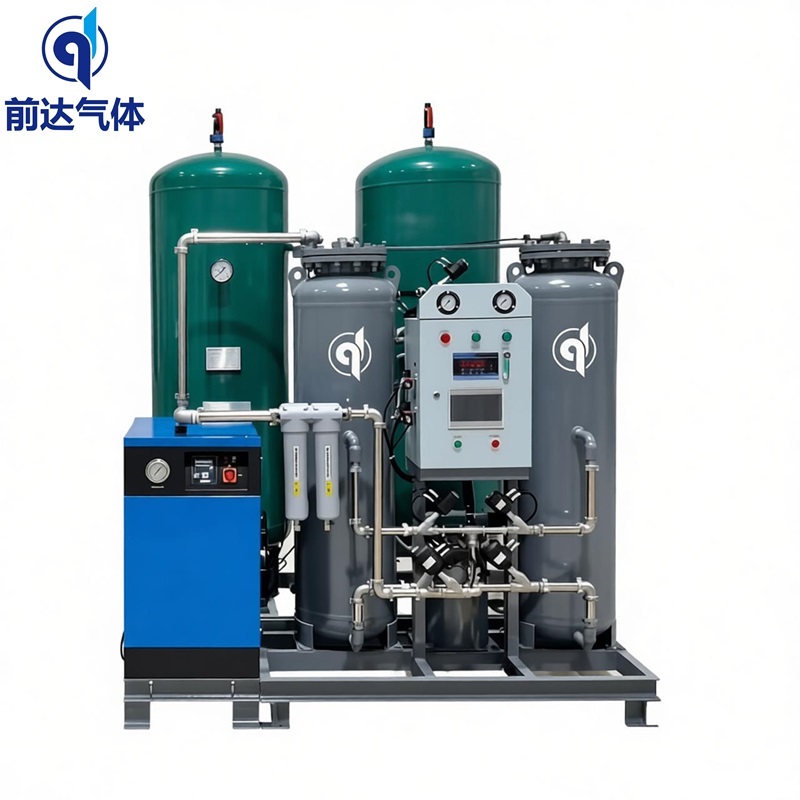
Modern systems are engineered as pre-commissioned, integrated units. A compact skid-mounted structure allows for minimal floor space usage, fast installation, and commissioning typically within 1–3 days. It is built for a true “plug-and-play” deployment.
2. Smart PLC Control & Remote Monitoring
Automation eliminates the need for manual oversight. Advanced PLC systems (such as Siemens or Delta) offer real-time purity monitoring. If nitrogen purity ever drops below your food-grade threshold, the system triggers an automatic venting valve to prevent bad gas from reaching your packaging lines, enabling 24/7 secure, unmanned operation.
3. Advanced CMS Compacting Technology
The heart of any PSA system is the Carbon Molecular Sieve (CMS). Premium manufacturers utilize high-efficiency CMS combined with advanced molecular sieve compacting technology (such as blizzard filling). This heavy-duty packing method prevents CMS tunneling, friction, and pulverization under high-pressure gas cycling, extending the core system lifespan beyond 10+ years.
4. Energy Efficiency Optimization
Advanced systems feature load-adjusted air compression controls and energy-saving PSA cycling algorithms. When your packaging lines slow down, the nitrogen generator automatically idles, reducing compressed air consumption and slashing your monthly electric bill.
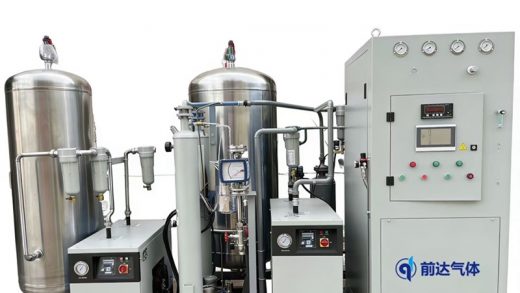
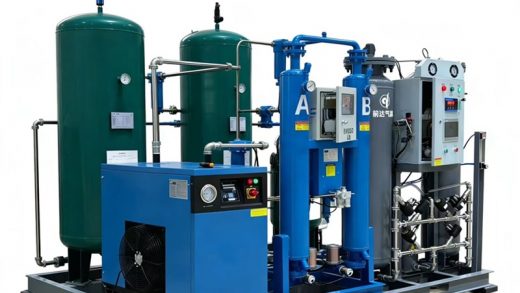
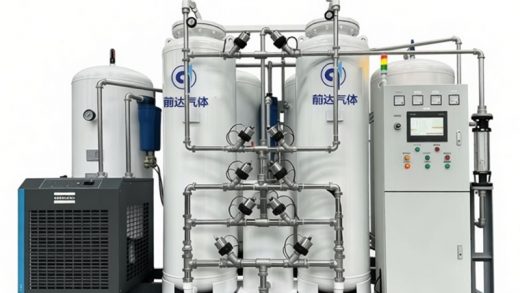
skid-mounted PSA nitrogen generator manufacturer
Conclusion: The Future of Food Packaging is Self-Sufficiency
The global food industry is rapidly shifting toward self-sufficient utility systems, and nitrogen is at the center of this transformation. Relying on continuous cylinder delivery or liquid nitrogen supply is no longer economically efficient or operationally stable.
By switching to On-Site PSA Nitrogen Generation, food manufacturers can achieve a stable, uninterrupted nitrogen supply, full compliance with global food safety standards, and immediate cost reductions that lead to a 12–24 month ROI. In a highly competitive food market, operational efficiency is no longer optional—it is survival.
🔥 Call to Action
Ready to eliminate your monthly nitrogen bills and upgrade to food-grade independence?
[Contact our application engineers today for a FREE Nitrogen Sizing & ROI Calculation] based on your specific packaging machines and production speeds. We will help you determine:
The optimal nitrogen purity for your specific food product.
Your exact required flow rate and peak demand buffer.
A customized energy consumption and utility cost estimate.
A precise payback period analysis for your factory location.
👉 Take control of your nitrogen supply—and your production costs—starting today.